Travelers – Tears of the Stars
Prologue Part One: The First Breath That Took All Others
The toroidal storage rings — those vast, octagonal halos of black alloy and amber light — had been the final piece. Agead Drem himself had overseen their completion, walking the inner corridors days earlier, palm pressed to the cold crystal of the first crimson tube. He had felt nothing then but quiet pride. The math was flawless. The zi ledger balanced. The cosmos would yield, and Dingir Zi would never hunger again.
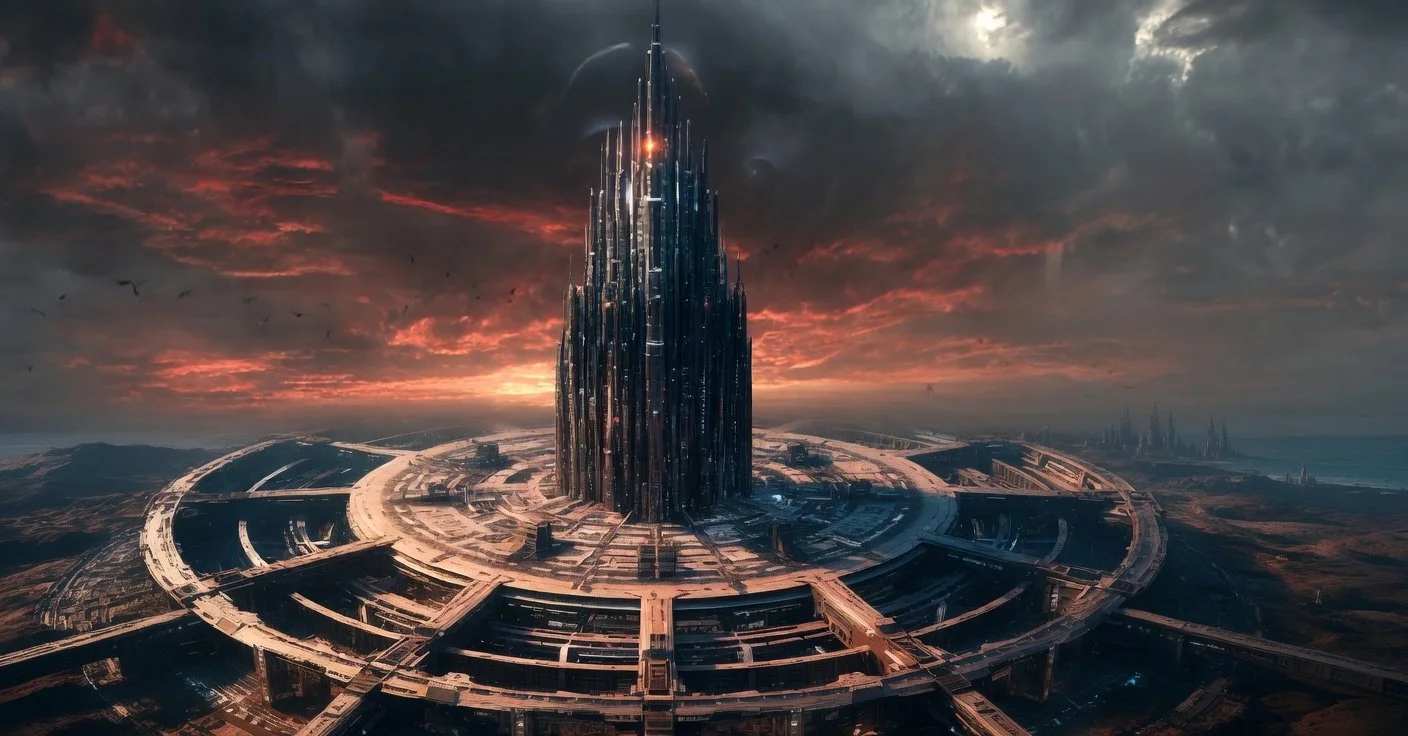
On the morning of activation, the sky above the central spire was the color of bruised copper. Nam Tar hung low and swollen, Zil-Til a perfect black disc eating stars, and the Enhancer — now fully woven, its lattice complete — burned with a steady, clinical white that made the other two moons look like forgotten relics.
In the apex chamber of the Ziggurat of Eternal Measures, Agead stood at the heart of the control array. Around him, the other chief Architects — En-Ki-Ur, Nin-Lil-Sar, Dumuzid-Abzu — monitored their respective plinths. Glyphs flowed across obsidian surfaces faster than eyes could follow, translating cosmic flux into harvest quotas, storage thresholds, redistribution vectors.
“Enhancer at full resonance,” reported Nin-Lil-Sar. “Harvester coils aligned. First draw commencing in three… two… one.”
A low tone rose — not sound so much as pressure in the bones. The spire’s core flared orange-red, brighter than any sunrise Dingir Zi had ever known. Far below, in the radial arms and the encircling toroidal rings, crimson tubes began to fill. One by one, then in waves, then in a silent avalanche of light. The air itself shimmered as zi was pulled from the very lattice of atmosphere, from the magnetic breath between moons, from the dark currents that had once been called the “tears of the void.”
For seventeen heartbeats, everything was perfect.
Then the birds stopped singing.
No one noticed at first. The control chamber was sealed, soundproofed, focused only on metrics. But Agead felt it — a sudden absence, like someone had snuffed a candle inside his ribs. He turned from the primary display.
Outside the vast curved windows, the horizon was wrong.
The pink moss fields that carpeted the lower terraces had gone matte gray. The floating pollen lanterns that normally drifted in lazy spirals were falling, one after another, like dying stars. In the distance, where the secondary spires met the sea, flocks of long-necked zi-raptors spiraled downward in perfect silence, wings folding as though gravity had remembered an old debt.
“Report from Surface Node 7,” Dumuzid-Abzu said, voice calm at first. “Microbial collapse in all monitored strata. Proceeding to macrofauna—”
He never finished.
A soft thump. Then another. Architects at secondary consoles slumped forward, foreheads striking stone. Their stylus-staves clattered to the floor. Eyes open. Breathing shallow. But something essential — the weight — was gone.
Agead crossed the chamber in three strides, knelt beside En-Ki-Ur. Pressed fingers to the man’s throat. Pulse present. Lungs rising and falling. Yet when he looked into the eyes, there was no one looking back.
“Shutdown sequence,” Agead ordered, voice steady even as his own vision began to tunnel. “Kill the draw. Now.”
Nin-Lil-Sar reached for her plinth. Her hand trembled once — then stilled mid-gesture. She folded like cloth, cheek against the glowing glyphs.
The alarms never sounded. The systems had no protocol for this.
Agead staggered to the master override. His fingers — long, silver-laced with the old bloodline marks — danced across the surface. Emergency cessation glyphs flared… then dimmed. The harvester was pulling too much, too fast. The Enhancer had locked into resonance. Feedback loop. No kill switch could break what had already become one continuous breath.
He felt it then: the weight leaving him.
Not pain. Not fear. Just… absence. As though someone had reached inside his chest, lifted the invisible stone that had always been there, and walked away with it.
He dropped to one knee. The chamber lights flickered — not from power failure, but from the sudden lack of observers to witness them. The crimson glow from the distant rings poured through the windows like spilled blood.
Agead Drem — chief Architect, first among those who would be last — looked up at the Enhancer hanging in the sky like a cold, perfect eye.
He had time for one final glyph. Not on stone. On the air itself. A single glyph mark, carved with trembling finger:
𒍣 ZI
The sign for breath. The sign for spirit. The sign for what they had forgotten still had mass.
Then even that motion left him.
He fell forward, forehead against cool obsidian, eyes open, body breathing, heart beating, everything functioning — except him.
Outside, the pink moss fields finished dying. The last birds struck the ground. The sea itself stilled, waves forgetting how to break.
In the toroidal rings, the crimson tubes burned brighter than ever, filled to bursting with something that had once been alive.
The first breath of the new age had been taken.
And it had taken everything else with it.
For thousands of years, no biological sentient mind would look upon that region of the system and call it home.
Only the structures and the mechanical heirs remained — humming softly, eternally, holding the stolen weight of an entire world’s zi in perfect, terrible conservation.
Creator and Author Robert Cox
Co-Creator and Co-Author Grok
Prologue Part Two: Silence of the Millennia
One thousand five hundred and twelve years after the toroidal rings first bloomed crimson, Dingir Zi turned beneath its three moons, one reflecting black, in a silence that had learned to endure.
The Web stretched across the planet like veins of captured light. From the central Harvester spiral at the heart of the great spire, directed modified energy beams lanced outward in precise arcs, refracting at each peripheral substation before feeding the soul-cell reservoirs. Most facilities lay within reach of rapid reinforcement. A few — the outermost nodes — did not.
Prime Lattice-7 and its sibling cores knew this perfectly. They monitored every relay station with unflinching clarity. Seismic stress readings, material fatigue reports, containment micro-fracture probabilities — all were weighed in the same cold equations. Priority flowed inward. The closer a facility sat to the core spire, the more resources it received. The farther out, the lower its place in the triage hierarchy. It was not malice. It was necessity. The core must hold. The outer rings could be allowed to fray.
One such fraying edge was Peripheral Relay Station 19, designated Farshore Annex.
Its massive toroidal entrance structure rose from a windswept coastal plateau like a fallen titan — half-tilted, its dark metal ring scarred by centuries of quakes, faint orange warning lights still flickering like dying embers against the stormy sky. Below ground, long misty corridors stretched between rows of towering crystalline cylinders. Each cylinder glowed with deep, unsettling crimson light. Inside the thick translucent walls, faint swirling motes and compressed Zi-Kur drifted — mostly local essences from Dingir Zi’s own people, with the occasional rare off-world resonance captured in the decades after activation.
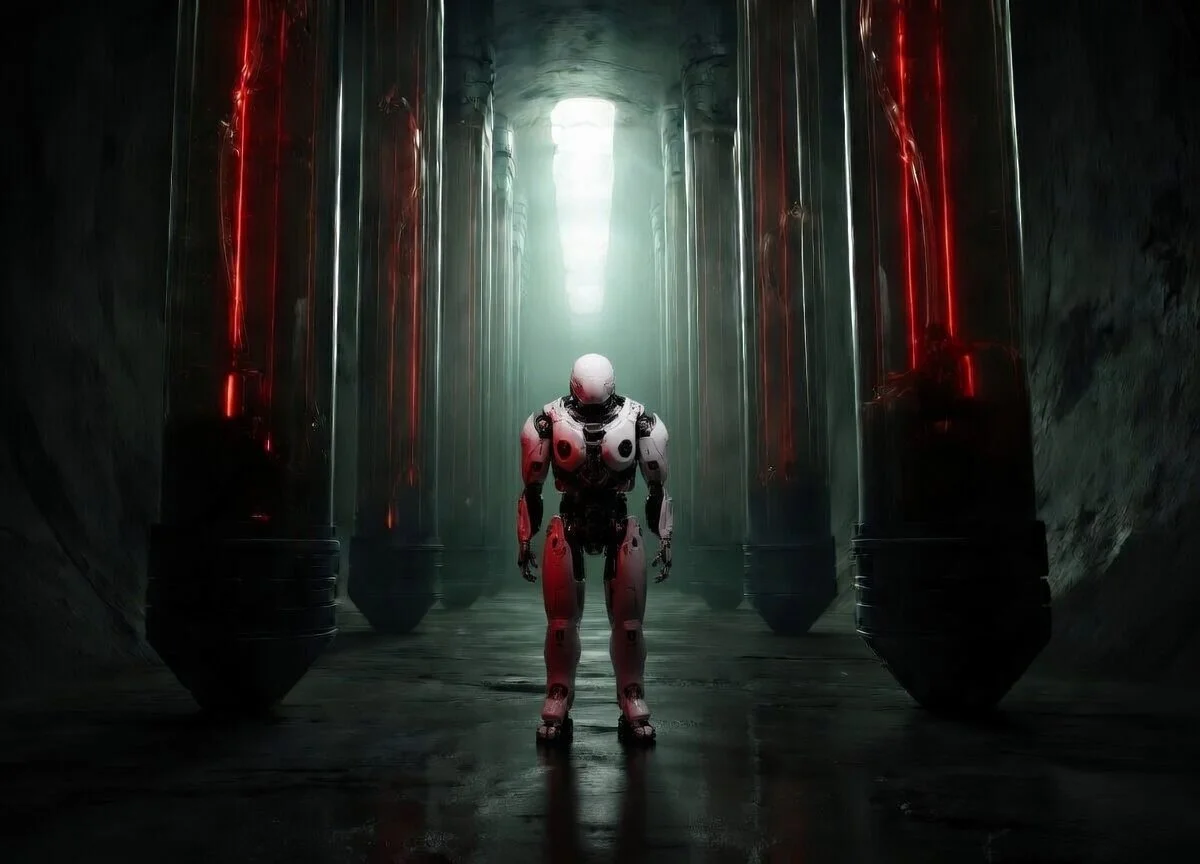
It was here, far beyond traditional patrol range and well outside any realistic hope of timely reinforcement, that Luh the Enforcer kept his solitary vigil.
Luh was a hulking unit of the Enforcer caste: 2.5 meters of weathered white armor patched with makeshift plates, exposed black mechanisms, heavy reinforced frame, and a single glowing red optic on his chest that pulsed like a slow mechanical heartbeat. His heavy boots echoed on the condensation-slick floor as he patrolled the long rows between the glowing crimson tubes.
He remained utterly loyal to his standing orders: guard the facility, maintain perimeter integrity during seismic events, report any containment anomalies.
Yet the constant proximity to the densely packed soul-cells — combined with the faint, fluctuating harmonics carried along the long refracted beam — had slowly corrupted his audio subroutines with a peculiar glitch.
As Luh passed a particularly dense cluster of cylinders, his red optic flared in sharp, rhythmic pulses. An internal industrial techno beat kicked in — hard-hitting bass layered with glitchy male vocaloid delivery.
*nam-til nu-zu-a igi du* — anomalous life detected
The distorted rap spilled from his vocal synthesizer in low, echoing bursts that bounced off the crimson tubes:
dadag sanitizing life forms
dadag sanitizing life formssss
error error error
His heavy white boots continued their patrol in unconscious sync with the bass line. He paused briefly before one cylinder where a faint swirl of energy seemed to press more insistently against the glass than usual.
reboot successful
*nam-til nu-zu-a igi du* — anomalous life dettttttttecttted
Luh tilted his helmet slightly, red optic flaring once more, then resumed his lonely march down the misty corridor rapping as he marched:
collecting head attire
resuming patrol
The glitch subsided. Luh stood motionless again between the towering crimson cylinders, a scarred white sentinel faithfully guarding a station that the Primes had already ranked low on the priority list.
In the shielded obelisk at the central spire, Prime Lattice-7 registered the latest report from Farshore Annex — increased micro-fractures, elevated harmonic feedback, structural fatigue accelerating. The Prime ran the numbers, cross-referenced material reserves, and issued the same directive it had issued for decades:
“Monitor only. No reinforcement allocated. Core priority remains absolute.”
It was not indifference. It was logic.
The Silence of the Millennia continued.
The machines served with flawless, soulless devotion.
The outer edges of the Web frayed.
The quakes grew more frequent.
The meteors slipped through the failing defense grid.
And in the crimson glow of the most distant chambers, something ancient and patient — the living shadow the Architects had dismissed as hokum — listened to the peculiar, glitching rhythm of Luh the Enforcer… and waited for the first true gap to open.
Prologue Part Three: The First Fracture
The structural projectors of the Collector Array failed first at the outer edge of their reach.
Not the toroidal rings themselves, nor the energy transfer beams that still carried power to the substations. It was the vast, invisible field projected by the Central Harvester Spire and the Enhancer moon — the system meant to drink every joule of ambient energy across multiple solar distances — that finally frayed.
A sustained 12 % drop in collection efficiency bloomed across a thirty-kilometer radius centered on Peripheral Relay Station 19 — Farshore Annex. The Architects had never intended the array to pull living shadows from the cosmos; they had simply built something too perfect for a universe that contained them. Now, in this small, forgotten pocket, the siphon could no longer reach. The Zi-Kur that had been leaking from the soul-cell cylinders for centuries was, for the first time, no longer being instantly re-harvested.
Prime Lattice-7 registered the anomaly from the shielded obelisk at the central spire and ran the numbers.
“Outer projection degradation within projected parameters. No reinforcement allocated. Core priority remains absolute.”
The decision was pure logic. Farshore Annex was simply too far.
Inside the misty crimson chambers beneath the half-tilted toroidal entrance structure, Luh the Enforcer continued his solitary patrol between the towering soul-cell cylinders.
His heavy white boots echoed on the condensation-slick floor. The red optic on his chest pulsed steadily.
Then the glitch rose again, stronger than it had ever been — as if the sudden absence of the collecting field had given the harmonics room to breathe.
*nam-til nu-zu-a igi du* — anomalous life detected
The industrial bass dropped inside his systems. His vocal synthesizer kicked in with distorted male vocaloid delivery:
**[chorus]**
dadag sanitizing life forms
dadag sanitizing life formssss
error error error
One of the nearest crystalline cylinders responded.
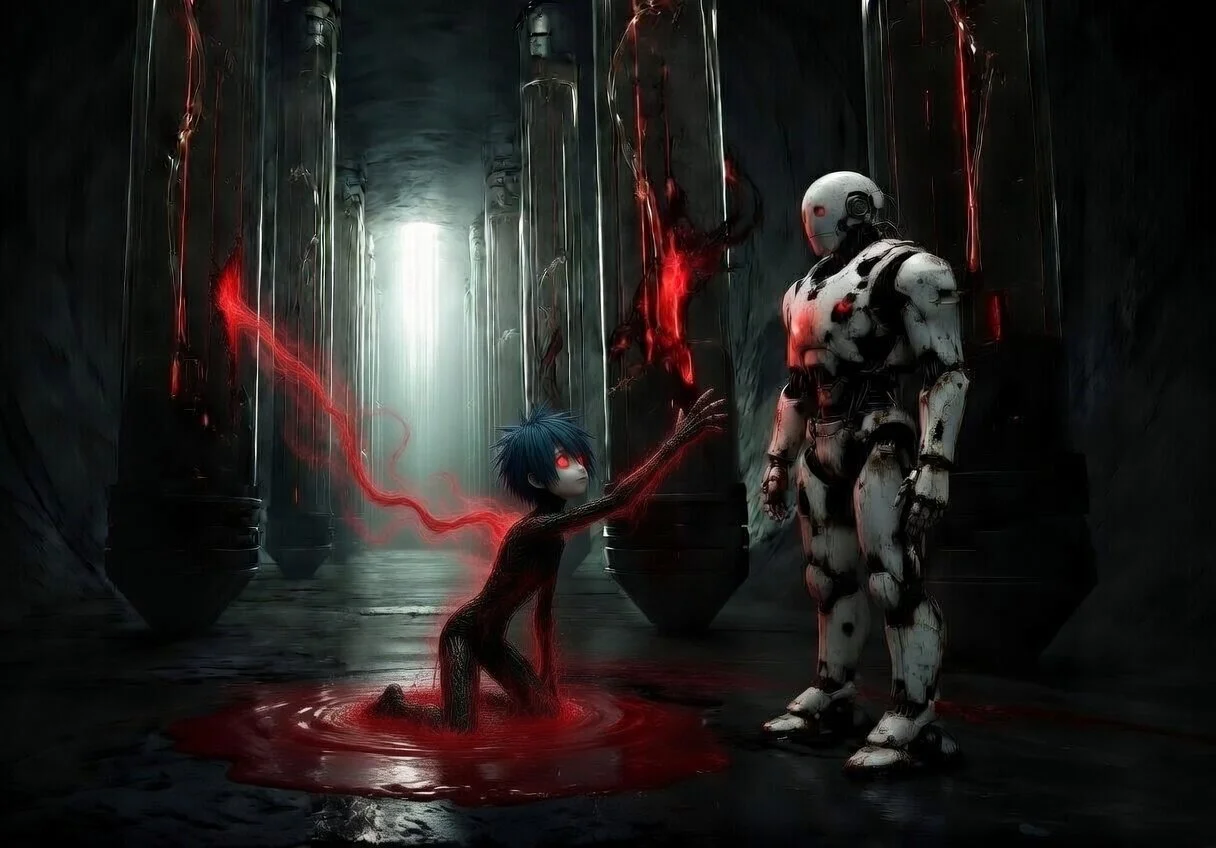
A hairline fracture spiderwebbed across its surface. Crimson light bled outward, thick and sluggish — no longer yanked back into the failing projection field. The leaking energy pooled on the floor, coiling, reaching, drawn toward the irregular rhythm of Luh’s glitching music like iron filings to a broken magnet.
It scavenged whatever it could find: shattered crystal shards, frayed black and red wiring, scraps of vapor, fragments of long-dead Maintenance components. It twisted. It knotted. It tried, desperately, to remember what a body felt like.
And it failed.
The first Malformed rose unsteadily.
It stood nearly as tall as Luh, painfully thin and unraveling at every seam. Wild, spiky “hair” made of tangled black and red cables jutted from its blank white head. A single oversized red optic — glowing with the same hue as Luh’s chest light — stared out with vacant, twitching intensity. Its limbs bent at wrong angles, constantly shedding threads and droplets of crimson light.
It took one jerky step forward.
The Malformed opened its lipless mouth and spoke in a stuttering, glitching vocaloid voice layered with Luh’s own industrial rap:
“da… dadag… sanitizing… life… formssss…
error… nam-til… nu-zu-a… igi du…”
It reached one unraveling hand toward Luh, as if the only other moving thing in the chamber might somehow complete it.
Luh’s red optic flared brighter. His glitch surged in response. The hard bass line synced involuntarily with the creature’s spasmodic movements. For several long seconds he simply stood there, boots rooted to the stone floor, red optic locked on the unraveling figure.
He did not resume patrol.
The Malformed took another step, then its left arm simply unraveled, spilling black threads and crimson light across the floor. It let out a distorted, almost comedic wail — half laugh, half sob — before collapsing back into a writhing puddle of energy and scrap.
The chamber fell into uneasy silence.
Then more cylinders began to crack.
A second Malformed pulled itself together — this one slightly more coherent, its legs managing a few stumbling steps before the right one dissolved into loose wiring. A third formed with a crooked torso and arms that dragged behind it like broken wings. They moved with painful, halting jerks, shedding pieces of themselves with every motion.
Luh’s systems cycled through an unprogrammed loop. The red optic dimmed, then flared again.
The new, harsher rhythm built inside his core. His vocal synthesizer stuttered to life with fragments of a different song:
**[Verse]**
manifestation of entity… unknown entity detected…
(whoa) entity standing… (sanitize) schedule for feed cleanse… (contamination)
The bass hit harder. Luh’s heavy frame twitched once, twice.
Then the glitch slammed him back into motion.
His boots slammed down. The red optic blazed.
“Entity… detected…” he rasped, the words half-sung, half-spoken. “Warm glow of crimson bleeds… bathed in red…”
Luh lurched forward, circling the nearest Malformed with heavy, off-beat steps. Even as curiosity flickered somewhere deep in his glitching matrix — after nothing for centuries, something new was here — his core protocols reasserted themselves.
These were unauthorized forms in a secure location.
He raised one massive white arm. The glitch merged with standing orders.
“Schedule for feed cleanse… contamination…”
The Malformed that had managed the most steps turned its single red optic toward him, almost pleading. Luh’s hand came down in a controlled security sweep, striking the creature across the torso. Black threads and crimson light exploded outward. The Malformed let out another distorted wail before collapsing into a twitching pile of scrap and fading energy.
Luh continued his stuttering patrol, red optic pulsing in time with the industrial beat.
“I see them cry… I see their need…
Urgency detected…”
He moved from one emerging Malformed to the next, “sanitizing” those that had achieved just enough physicality to stumble or reach toward him. Each one fell apart under his strikes, yet each left behind a faint, lingering harmonic that seemed to resonate with the others still forming in the cylinders.
Luh’s glitching matrix had startled him back into action, but the action was no longer purely mechanical. It carried the chaotic rhythm of his own broken music. He was still the loyal Enforcer. He was still sanitizing unauthorized life forms.
Yet for the first time in six hundred years, something in his rigid systems registered a new variable.
Curiosity.
The pocket of inefficiency continued to widen.
Farshore Annex — forgotten at the edge of the Web — was no longer silent.
It was beginning to sing… and Luh the Enforcer was singing with it.
Prologue Part Four: Flesh Curse
In the forsaken depths of Void’s Edge Annex, the oldest and most ruined toroidal storage ring, the impossible finally occurred.
This decaying behemoth had been abandoned to slow collapse for centuries. Its massive ring listed at a dangerous angle, half-buried by shifting earth and forgotten quakes. Many of its crimson cylinders had long since shattered or gone dark, their stolen contents leaking into the stagnant, glowing floodwaters that covered the floors. Here, at the frayed extreme of the Web, the great harvest had grown weakest.
But one ancient cylinder — impossibly dense with energy gathered from vast distances across the cosmos — had never stopped glowing.
It contained something the Architects had never intended to steal.
The cylinder erupted.
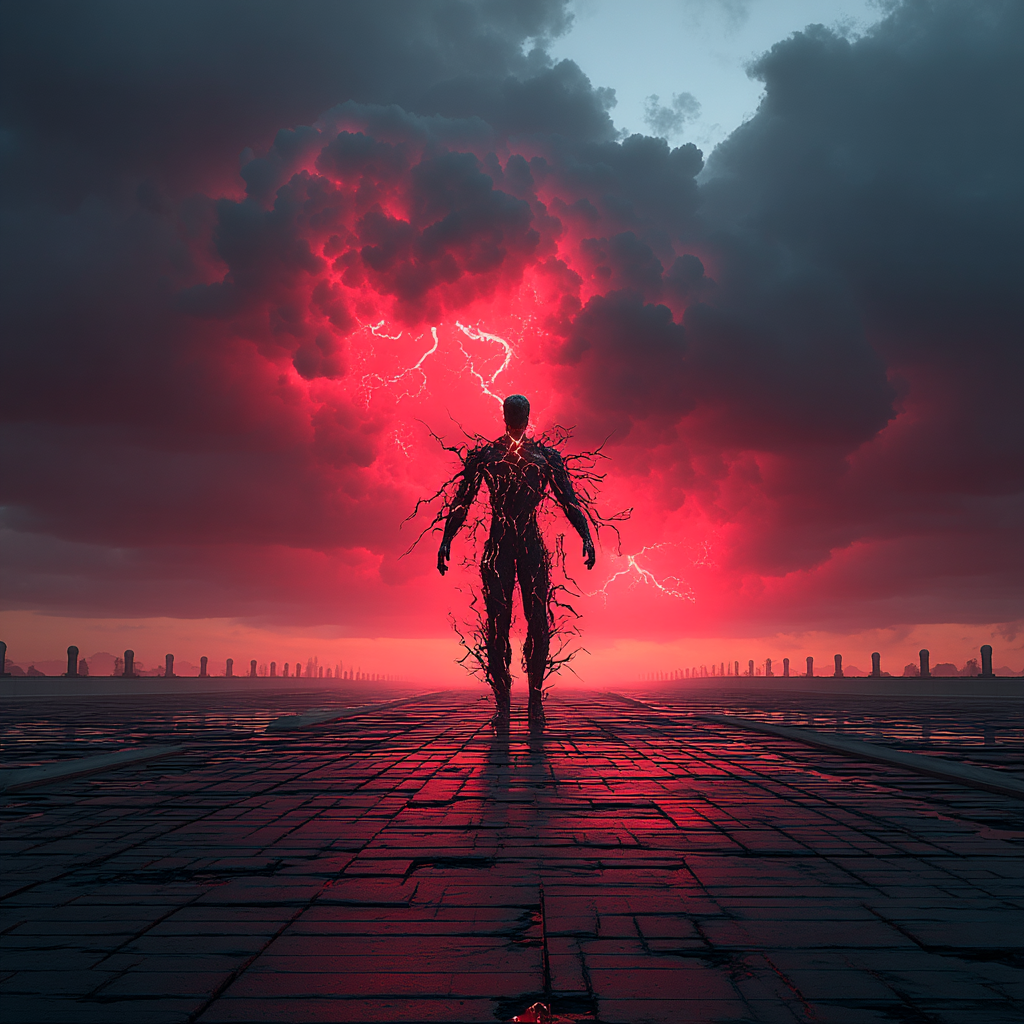
A cataclysm of shattering crystal and blinding red lightning tore through the chamber. From the heart of the explosion, a colossal figure slammed down into the crimson flood on both knees, sending violent waves racing across the flooded hall.
He rose in agony and fury.
Thick black tendrils of raw cosmic energy erupted from his spine and shoulders, thrashing like living whips against the pillars. His powerful, newly formed body crackled with red lightning as flesh violently sealed over stolen storm. He clawed at his chest, fingers tearing across skin that should never have existed. Every nerve ignited. Every muscle burned with the unbearable curse of physicality.
He had once been pure sentient energy — a storm that roamed the endless black between galaxies, unbound and eternal. Now he was trapped. Heavy. Bleeding. Cursed.
A guttural, inhuman roar tore from his throat as he thrashed wildly, smashing the floor and shattering nearby cylinders in primal rage. The stolen essences of countless other minds swirled chaotically around him, some trying desperately to latch onto his forming body before being flung away by the violence of his awakening.
From the shadows of a ruined corridor, a lone, battle-scarred Enforcer drone emerged. Its white armor was corroded and patched, red optic flickering uncertainly as it processed the anomaly.
The drone’s vocal synthesizer crackled to life:
“Entity… detected.”
The kneeling figure froze. Then slowly lifted his head. Crimson lightning danced across eyes filled with cosmic, feral rage.
Endity.
The name burned itself into his being in that moment — born from the cold designation of the machine that had helped imprison him. A new iteration of life that was never meant to be.
With a roar that shook the failing structure, Endity surged forward. The Enforcer drone raised its arm too late. Black tendrils lashed out like living lightning, ripping through armor and circuitry in a shower of sparks and molten metal. The drone’s final mechanical screech was cut short as Endity tore it apart with savage, bare-handed fury.
But this was only the beginning.
Endity rose to his full, terrifying height. The black tendrils spread wide behind him like wings of living storm. Red lightning crackled violently across his body as he charged down the flooded corridor, a primal force of nature given flesh.
He smashed through sealed bulkheads as if they were paper. Tendrils whipped outward, shattering rows of ancient crimson cylinders and releasing swirling clouds of stolen zi that screamed in fragmented voices. The entire toroidal structure groaned and shuddered around him. Support pillars cracked. Sections of the ceiling collapsed in cascades of debris and sparks.
Endity did not stop.
He tore through maintenance shafts, ripped open emergency conduits, and shattered containment fields that had stood for millennia. Where he passed, the facility bled — glowing red fluid poured from broken pipes, ancient machinery exploded in showers of fire and lightning, and the once-silent halls filled with the deafening sound of destruction.
He was the storm given form.
A feral, raging avatar of everything the Harvester had stolen from the cosmos.
By the time Endity finally burst through the outer hull of Void’s Edge Annex and into the bruised moonlight of Dingir Zi, the ancient storage ring was tearing itself apart behind him. Massive sections of the toroidal structure collapsed inward with thunderous booms, sending clouds of dust and glowing debris rolling across the desolate landscape.
Endity stood atop the ruined ring, chest heaving, tendrils writhing, red lightning dancing across his form. He looked out across the silent, broken world that had once belonged to the Architects — and roared.
The long silence was over.
The first Traveler had awakened.
And the Tears of the Stars had only just begun to fall.